
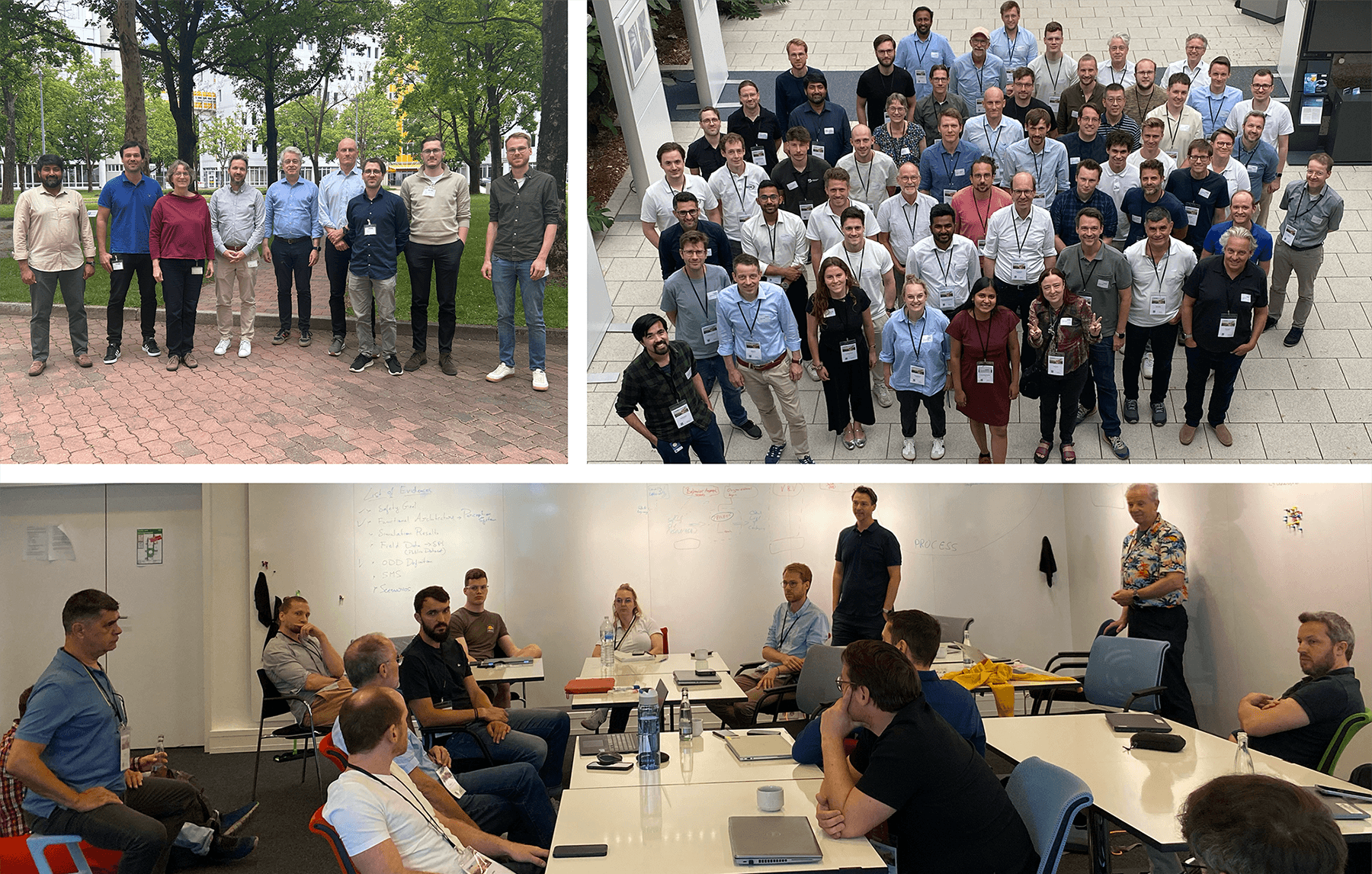
The consortium meeting and V&V workshop marked significant progress in addressing uncertainties in automated driving.
The research project CONTROL has reached important milestones towards the project’s main challenge: how highly automated transportation systems can operate safely even in complex and difficult-to-predict situations. Recent meetings of the consortium in Kaiserslautern and a dedicated Verification & Validation (V&V) workshop in Munich brought project partners together to align technical developments, strengthen collaboration, and define priorities for the next project phase.
On 7 and 8 July 2026, the CONTROL consortium gathered in Kaiserslautern for its third General Assembly, hosted by Fraunhofer IESE. A key topic of discussion was the identification, assessment, and management of uncertainties throughout the perception chain. Partners examined different types of uncertainties, including product, process, and argumentation uncertainties, and discussed their implications for future assurance concepts. Demonstrator developments presented during the meeting highlighted a broad range of approaches, including Software-, Model-, and Vehicle-in-the-Loop methods, sensor fusion concepts, and techniques for quantifying and handling perception uncertainties.
In parallel workshops, consortium members worked on architecture and interface topics, quality metrics, adaptation mechanisms, the Minimum Viable Product (MVP), and the integration of product and process uncertainties into the overall project framework. The intensive exchange provided valuable insights that will help shape upcoming project milestones and support the continued development of safe automated driving technologies.
Complementing the discussions held during the consortium meeting, a dedicated Subproject 5 workshop hosted by Siemens AG in Munich focused on advancing key methods, tools, and processes for verification and validation within CONTROL’s safety framework.
Discussions concentrated on three major areas: improving traceability between safety argumentation and supporting evidence, refining approaches for deriving validation objectives, and advancing cross-domain scenario-based validation methods with particular attention to uncertainty management. The workshop also highlighted the growing importance of simulation-based evidence generation as a cornerstone for future validation activities.
Subproject 5 plays a central role within CONTROL by operationalising risk acceptance criteria and implementing the project’s Verification & Validation concept for both the vehicle and its perception chain. Through simulation-based tools and methodologies, the partners aim to ensure a transparent and traceable connection between safety arguments and the evidence used to support them.
Both events underlined the collaborative nature of the project and demonstrated the strong commitment of all partners to developing innovative approaches for safe decision-making in automated driving. The discussions and results achieved in Kaiserslautern and Munich will provide valuable insights for the next stages of the project and contribute to a shared understanding of how uncertainties can be addressed across domains, methods, and technologies.
As the project moves forward, the insights gained from these meetings will be integrated into future developments, demonstrators, and validation activities.
Images: KIT, EICT, Infineon for CONTROL Consortium