

“
Bewegung in einer dynamischen Welt heißt: jederzeit reagieren können – auch auf seltene, kritische Situationen. Weil solche Fälle kaum real zu testen sind, entwickeln wir in CONTROL kostengünstige, verlässliche Nachweisverfahren. Gemeinsam schaffen wir praxistaugliche Werkzeuge, Modelle und Architekturen, die hochautomatisiertes Fahren auf Straße und Schiene sicherer machen.
Prof. Dr.-Ing. Michael Buchholz
Universität Ulm
CONTROL builds trust
Ensuring quality, understanding mobility systems.
Discover how the research project makes uncertainties manageable and accelerates innovation in the mobility sector.
► Highly automated systems in traffic must be able to respond safely to a wide range of possible situations in open, dynamic environments, including rare and unpredictable events. Current methods reach their limits, especially in complex operational areas that are difficult to foresee.
► The research project CONTROL addresses this challenge in a cross-domain and forward‑looking manner, covering automotive, commercial vehicle and rail applications. In road traffic, situations such as suddenly appearing pedestrians in obscured areas, unexpected construction zones, faulty or contradictory traffic signals, extreme weather impairing sensors, or technical malfunctions within the vehicle are key concerns. These scenarios are currently hardly covered in a systematic way. In the rail domain, additional challenges arise, for example people or obstacles on the track.
► Highly automated systems must reliably detect and assess such safety‑critical situations. CONTROL is developing a cross‑industry, systemic approach to achieve this. The project focuses on the highly automated vehicle, including passenger cars, trucks, buses, and trains, as an integrated system for evaluating and managing uncertainties.
CONTROL BUILDS TRUST
Ensuring quality, understanding mobility systems.
Discover how the research project makes uncertainties manageable and accelerates innovation in the mobility sector.
► Highly automated systems in traffic must be able to respond safely to a wide range of possible situations in open, dynamic environments, including rare and unpredictable events. Current methods reach their limits, especially in complex operational areas that are difficult to foresee.
► The research project CONTROL addresses this challenge in a cross-domain and forward‑looking manner, covering automotive, commercial vehicle and rail applications. In road traffic, situations such as suddenly appearing pedestrians in obscured areas, unexpected construction zones, faulty or contradictory traffic signals, extreme weather impairing sensors, or technical malfunctions within the vehicle are key concerns. These scenarios are currently hardly covered in a systematic way. In the rail domain, additional challenges arise, for example people or obstacles on the track.
► Highly automated systems must reliably detect and assess such safety‑critical situations. CONTROL is developing a cross‑industry, systemic approach to achieve this. The project focuses on the highly automated vehicle, including passenger cars, trucks, buses, and trains, as an integrated system for evaluating and managing uncertainties.
System approach of CONTROL
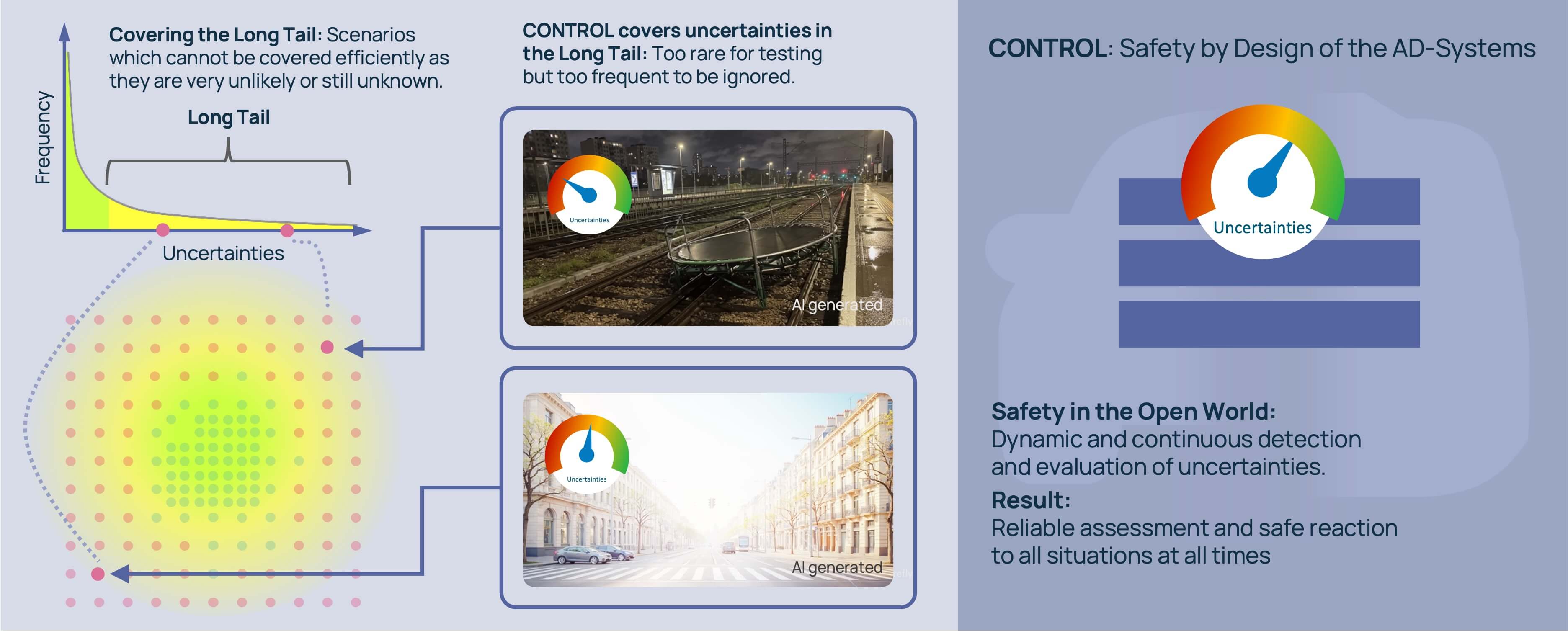
System approach of CONTROL
(Click to enlarge)
CONTROL Subprojects (SP)
SP1
The SP QUALITY METRICS AND QUALITY GUARANTEES develops the foundations for safe perception chains.
It models how uncertainties arise and propagate along the sensor and data processing pipeline. It develops methods for causal modelling, defines quality metrics for quantification, and derives probabilistic quality guarantees.
SP2
Precise SENSOR MODELS for road and rail are being developed to systematically capture and quantify uncertainties.
Both during development and at runtime, environmental factors such as weather or interference effects are integrated. Methods for real time assessment of sensor data enable adaptive, trustworthy sensor fusion. Validation using measurement data and simulations ensures practical applicability.
SP3
MODELS FOR SENSOR FUSION that capture, quantify, and evaluate uncertainties are being developed.
Across the entire perception chain during runtime, the goal is continuous monitoring of fusion quality, detection of deviations, and provision of adaptive, modular fusion components. This ensures the integrity of the perception chain and creates the foundation for upgrades and the integration of new sensors.
SP4
An ADAPTIVE PERCEPTION CHAIN that identifies and responds to uncertainties is being developed.
At its core is a Smart Abstraction Model that demonstrates uncertainty propagation and selects optimal configurations at runtime. The SP4 integrates sensor and fusion models into physical virtual simulations. It also defines interfaces and validation environments for open and closed loop tests, enabling provably safe, adaptive systems.
SP5
The SP develops METHODS, TOOLS, AND PROCESSES FOR ASSURANCE under uncertainty.
Its core is an end to end risk management approach across the entire lifecycle, complemented by risk acceptance criteria and a V&V concept for the vehicle and its perception chain. SP5 operationalises these concepts with simulation based tools and ensures traceability between the safety argumentation and supporting evidence.
SP6
A CROSS DOMAIN FRAMEWORK FOR SAFETY ARGUMENTATION in road and rail contexts is being developed.
It harmonises existing approaches, and addresses the credibility of virtual V&V as well as lifecycle oriented argumentation. It provides tool support and ensures transfer into practice through reference examples and MVP demonstrators, enabling scalable and transparent safety cases throughout the entire lifecycle.
Facts & Figures
Consortium Lead
Dr. Cornel Klein
(Siemens)
Dr. Sanwardhini Pantawane
(Valeo)
Consortium
24 Partner: OEMs, Zulieferer für den Straßen- und Schienenbereich, Technologiepartner, Forschungseinrichtungen
Duration
36 months
01 October 2025 – 30 September 2028
Project Budget
29 Mio. €
Funding
15,6 Mio. €
Facts & Figures
Consortium Lead
Dr. Cornel Klein | Siemens
Dr. Sanwardhini Pantawane | Valeo
Consortium
24 Partners: OEMs, suppliers, technology providers, research institutions, external partners
Duration
36 months
01 October 2025 – 30 September 2028
Project Budget
29 Mio. €
Funding
15,6 Mio. €